

Flat Ribbon Cable Assemblies
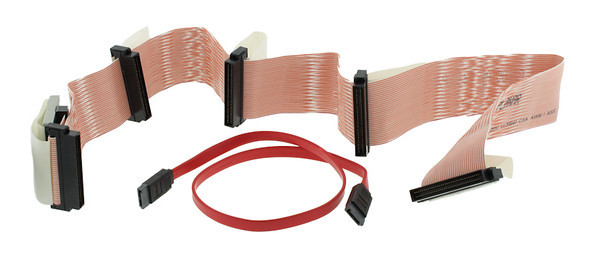
Flat ribbon cable assemblies consist of parallel conductors arranged in a flat, rectangular configuration that helps simplify routing in confined spaces. Epec specializes in custom ribbon cable assemblies that incorporate bends, folds, soldering, custom terminations, and other nonstandard requirements for complex electronic applications. Ribbon cables are traditionally paired with IDC (insulation displacement connector) style connectors that are available in a range of configurations and pin counts. Color coding, printed markings, and custom folding can improve installation, orientation, and assembly efficiency.
At a Glance: Ribbon Cables
- Flexible, space-saving cable design: Flat ribbon cable assemblies use parallel conductors in a low-profile configuration, making them well suited for routing connections in confined electronic assemblies.
- Custom folding and termination options: Epec specializes in ribbon cable assemblies that require custom conductor counts, folds, bends, soldering, and specialized terminations for complex, nonstandard applications.
- Simplified installation and conductor identification: Color coding, striped markings, and custom assembly features help support correct orientation, reduce the risk of reversed connections, and streamline final system assembly.
Flat Ribbon Cable Overview
Ribbon cable, also known as flat ribbon cable or sometimes planar cable, is designed with a flat, rectangular profile. The conductors run parallel to one another in the same plane, creating a cable that is both wide and flat in shape. Each conductor is fused on each side, creating the desired cross-section. Epec manufactures several UL-rated ribbon cables, including UL2651, which is a common 300V and 105°C rated extrusion.
Epec focuses on custom ribbon cable solutions that require custom extrusions, bends, folded configurations, soldering, specialty terminations, overmolding, or other specialized assembly requirements.
The primary benefit of a ribbon cable is its combination of a low-profile shape and flexibility. This design makes it easier to route cables through confined spaces or applications where limited room exists between connected components. Another benefit to using ribbon cables is that they are designed to be quickly assembled to IDC style connectors that have the same pitch or spacing between conductors. To simplify installation and reduce the possibility of reversed connections, ribbon cables are commonly color-coded, striped, or edge-marked to identify conductor orientation.
See our blog post that outlines the guide to ribbon cable assemblies for more information.
Flat Ribbon Cable Benefits
Ribbon cables provide a flexible and space-efficient method for connecting electronic components. Their flat construction supports routing through tight spaces while maintaining conductor organization.
Additional benefits include:
- Easier routing in space-constrained applications
- Simplified conductor identification through color coding or striped marking
- Reduced risk of incorrect connector orientation
- Compatibility with mass-termination IDC connector systems
- Extremely small minimum bend radius in certain directions
- Low-profile cable management
- Availability in a range of conductor counts and conductor spacing options
Folded Flat Ribbon Cable Assemblies
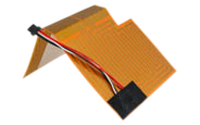
Flat and ribbon cables can be folded into custom configurations when spacing limitations affect system design. In applications where folded cable routing is preferred, cables can be pre-creased to help limit the stress normally associated with standard folding methods.
By incorporating cable folding during the assembly process, finished assemblies arrive ready for installation, helping streamline final assembly operations. Producing complete and permanent folds requires specialized tooling and equipment to ensure consistent results.
Color-Coded Ribbon Cables
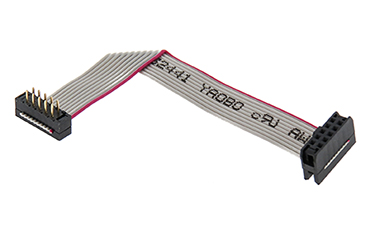
A color-coded ribbon cable, sometimes referred to as a rainbow ribbon cable or twist-and-flat cable, uses a repeating color sequence to identify individual conductors.
This repeating pattern typically follows the industry-standard resistor color code. Brown is commonly assigned to conductor and pin positions 1, 11, and 21, while red is commonly assigned to conductor and pin positions 2, 12, and 22. Color-coded ribbon cables may consist of insulated conductors positioned in parallel or may be manufactured with twisted pairs that include repeating flat sections for termination at specified length intervals.
Edge Marked Ribbon Cables
An edge-marked cable generally includes a stripe on the first conductor, which corresponds to pin 1 on the connector. Edge markings may be produced in different colors, although the color often corresponds to cable pitch or center spacing. For example, a gray cable with a 0.050-inch pitch is typically marked with a red edge stripe to denote pin 1.
Edge marking and stripes are well suited for applications that use two or more IDC connectors where every connector position is connected to a corresponding conductor. When individual wires or small conductor groups require separate termination, additional conductor markings may be added to support proper identification and termination.
Flat Ribbon Cable Applications
Ribbon cables have long been used as interconnects for internal computer peripherals, including hard drives, CD drives, and floppy drives. They have also been used for external connections on older computer systems.
The flat profile that makes ribbon cables useful for routing can also disrupt airflow inside computer enclosures. Ribbon cables are also able to be bent in tight bend radii in two directions, up and down, allowing them to route through near 90-degree bends. As a result, round cable designs have increasingly replaced ribbon cables in many external and internal computer applications.
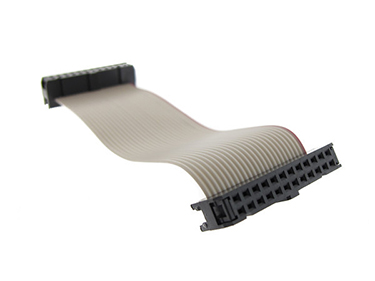
Ribbon cables were originally used in the mainframe computer industry, including card readers, card punching equipment, and tape machines. As manufacturing methods and materials evolved, the design became more standardized and cost-effective. Standardized wire spacing enabled straightforward termination using IDC connectors, contributing to continued use in computers, printers, and many electronic devices.
Ribbon Cable Specifications
Ribbon cables are commonly specified using three primary characteristics:
- Conductor spacing (pitch)
- Number of conductors (conductor count)
- Wire size (AWG)
Ribbon Cable Specification Table
| Parameter | Value | Units |
|---|---|---|
| Common conductor pitch | 0.050 | inch |
| Available conductor pitch range | 0.025 to 0.156 | inch |
| Minimum pitch found in some portable electronic equipment | 0.3 | mm |
| Available conductor counts | 4, 6, 8, 9, 10, 14, 15, 16, 18, 20, 24, 25, 26, 34, 37, 40, 50, 60, 64, 80 | ways |
| Typical wire size range | 18 to 34 | AWG |
A conductor spacing of 0.050 inch using 28AWG wires is the most common configuration, although finer and coarser pitches are available. Standard pitch options range from 0.025 inch to 0.156 inch, with custom spacing available depending on application requirements. In some portable electronic equipment, cable pitches as small as 0.3 mm may be used.
The number of conductors is often influenced by standard connector availability. Common conductor counts include 4, 6, 8, 9, 10, 14, 15, 16, 18, 20, 24, 25, 26, 34, 37, 40, 50, 60, 64, and 80. Ribbon cables typically use stranded copper wire ranging from 18 AWG to 34 AWG or finer.
Ribbon Cable Advantages
One of the primary advantages of ribbon cables is their ability to support mass termination using insulation-displacement connectors (IDC). Ribbon cables may also be terminated using crimp contacts or solder-bucket connections.
IDC termination creates an electrical connection by forcing a sharpened blade through the wire insulation, eliminating the need to strip insulation before termination. IDC connectors are generally categorized by pin spacing, number of pins, and number of rows. While the assembly process is simplified, IDC connectors still require special tooling to press down the IDC components and pierce the cable jackets.
Frequently Asked Questions
Quick Links
- What is a flat ribbon cable?
- What are the main benefits of ribbon cables?
- Why are ribbon cables color-coded or edge-marked?
- What is a folded flat ribbon cable assembly?
- What is the difference between a color-coded ribbon cable and an edge-marked cable?
- What conductor pitches are available for ribbon cables?
- How are ribbon cables terminated?
What is a flat ribbon cable?
A flat ribbon cable is a cable with parallel conductors arranged on the same flat plane. Its flat, rectangular shape gives it the appearance of a ribbon and supports routing in limited spaces.
What are the main benefits of ribbon cables?
The primary benefits are their flat profile and flexibility. These characteristics help simplify cable routing in confined spaces and support connections between components where installation space is limited.
Why are ribbon cables color-coded or edge-marked?
Color coding, stripes, and edge marking help identify conductor orientation, simplify installation, align conductors with connector pins, and reduce the risk of reversed connections.
What is a folded flat ribbon cable assembly?
A folded flat ribbon cable assembly uses custom folds or bends to accommodate spacing constraints. Pre-creased folding can help reduce stress that would otherwise occur during conventional folding processes.
What is the difference between a color-coded ribbon cable and an edge-marked cable?
Color-coded ribbon cables use repeating conductor colors for identification. Edge-marked or striped cables use a colored stripe on the first conductor, typically corresponding to pin 1, to indicate orientation.
What conductor pitches are available for ribbon cables?
The most common conductor pitch is 0.050 inch. Standard options are available from 0.025 inch to 0.156 inch, and some portable electronic equipment uses cable pitches as small as 0.3 mm.
How are ribbon cables terminated?
Ribbon cables are commonly terminated with insulation-displacement connectors (IDC), though crimp contacts, soldered connections, and overmolds may also be used. IDC termination connects conductors without requiring insulation removal before termination.
Need Custom Ribbon Cables?
Epec provides custom ribbon cable assemblies for applications requiring specialized routing, folded cable configurations, soldering, custom terminations, and other nonstandard assembly requirements. Custom ribbon cable solutions can help maximize flexibility and performance in complex applications where available space is limited.
Request a Quote Request Design Support Request More InformationRequest a FREE Quote!
We are here to help create a cable assembly that will exceed your requirements.
Get Your Quote Now! Not Ready for a Quote? Request more info or email us your inquiry.